

Discovering the Baritone Ukulele: A Perfect Starter Instrument

Updated: Sep 28
So Many Ukuleles… Which One Is Which?
How often have you walked past a wall of ukuleles in a music shop and wondered about all of them? They look so similar… yet they can be surprisingly different!
So, what exactly is a Baritone Ukulele?
Just like the other members of the ukulele family, the Baritone has four strings. It is lightweight, easy to hold, and has tuning pegs that allow you to tune each string individually. But that's where some of the similarities end.
What Makes a Baritone Ukulele Different?
The Baritone Ukulele is the largest of the standard ukulele sizes, and it has a longer neck and larger body than a Soprano, Concert/Alto, or Tenor ukulele.
Its strings are also different from the strings you'll typically find on the smaller ukulele sizes. Baritone ukulele strings are designed for the instrument's longer scale and are generally nylon or nylon-based strings wrapped in a metal like bronze or silver-plated copper.
And there's another very important difference…
The Tuning!
Soprano, Concert, and Tenor ukuleles are typically tuned:
G – C – E – A
But the Baritone Ukulele is tuned:
D – G – B – E
Do those four notes sound familiar? They should!
D – G – B – E are the same notes as the four highest-pitched strings on a standard guitar.
In other words, a Baritone Ukulele is tuned like the upper four strings of a guitar—just without the guitar's two lowest strings, E and A. So in a way, the Baritone Ukulele is like a smaller, more approachable introduction to playing guitar.
Playing Popular Chords Just Got a Lot Easier!
Now that we know the Baritone Ukulele is tuned like the four highest strings of a guitar, you can probably guess where I'm going with this…
The chord shapes are very similar to guitar! And because you're only working with four strings instead of six, some chords can feel much more manageable.
Take the F Major chord, for example. On a guitar, F Major is one of those chords that many beginners struggle with because it often involves a barre across multiple strings.
On a Baritone Ukulele, you're working with only four strings, which can make the chord much more approachable.
Don't believe me?
Take a look at the diagram below:
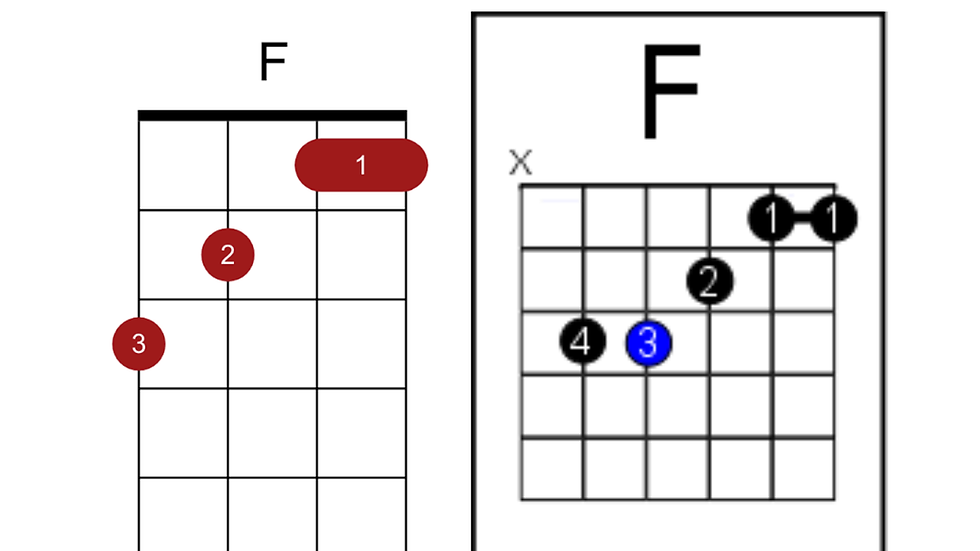
Left: F Major on Baritone Ukulele | Right: F Major on Guitar
See the difference? And F Major isn't the only chord that can feel easier to manage. Once you start learning the Baritone Ukulele, you'll encounter familiar guitar-style chord shapes for chords such as:
C Major, G Major, D Major, D Minor, A Major, A Minor, E Major, E Minor, and many more.
And once you know those chords, you can start learning a LOT of your favorite songs. That's where the magic happens. Because when you can pick up an instrument and actually play a song you love, learning suddenly becomes a whole lot more fun!
A Guitar, But a Little More Approachable
Here's a quick comparison:
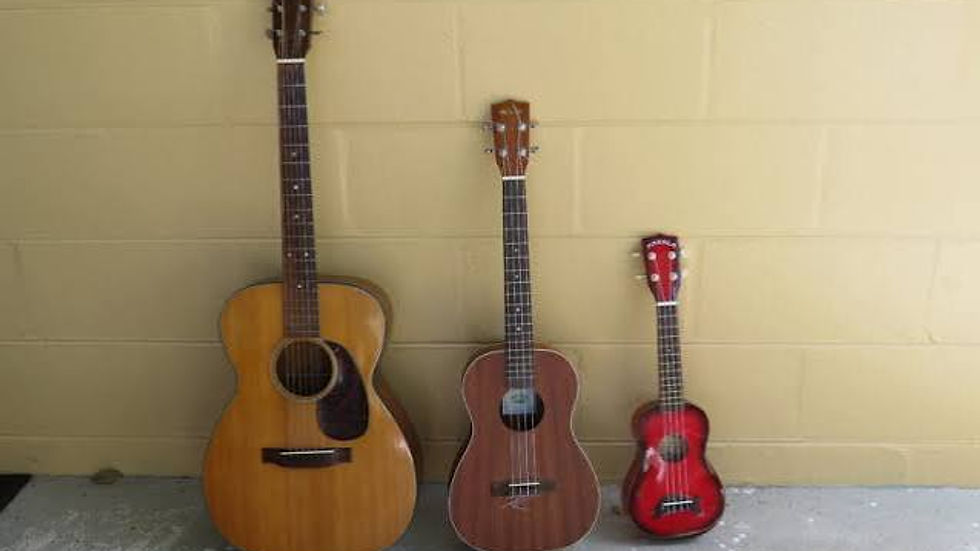
Left to right: A guitar, a Baritone Ukulele, and a Soprano Ukulele
The Baritone sits right in that sweet spot. It's smaller and lighter than a guitar, but its tuning and chord shapes provide a natural stepping stone toward learning guitar.
And because it has fewer strings and is so portable, it can be much less intimidating for a beginner. It's also easy to take with you when you're traveling. Heading out of town? Bring your Baritone Ukulele along and keep practicing wherever you go!
Why Start With a Baritone Ukulele Before Guitar?
For many beginners, the biggest challenge isn't learning the notes or chords—it's simply getting comfortable with the instrument. The Baritone Ukulele can make that process feel less overwhelming.
It's lightweight, portable, has only four strings, and uses the same tuning as the four highest strings of a guitar. That means you can start developing your finger strength, chord knowledge, rhythm, and confidence while playing songs you actually enjoy. And once you're ready to pick up a guitar, you'll already have a head start.
Is the Baritone Ukulele Good for Kids?
Absolutely! If you have an older child who wants to learn guitar, especially around age 8 and up, why not let them try a Baritone Ukulele first? It can be a fun and approachable way to introduce them to string instruments without immediately putting a full-size guitar in their hands.
And the best part? They can start playing songs they love right away. If you'd like your child to try the Baritone Ukulele, or you'd like to learn yourself, consider signing up for private lessons with me. We'll get you playing songs by your favorite artists and having fun with the instrument in no time!
Who knows? Your next favorite instrument might just be the Baritone Ukulele!
Sign up for your first private lesson today by visiting the **Student Portal**
The Importance of Music Education for Children
It's important that we offer families and children a safe place to explore music. Music supports the development of motor skills, language skills, and social skills. It also helps children develop empathy. By introducing music at an early age, we can nurture their growth in these areas.
At Treble Time Music Studios, our goal is to inspire a lifelong love of music beginning from a child's earliest years and continuing throughout their life. We are committed to creating a nurturing, low-pressure learning environment where children can explore music with confidence, curiosity, and joy.
Our studio is built on the belief that meaningful musical growth happens when the focus is placed on the process rather than the performance. Through personalized instruction and developmentally appropriate teaching methods, we help children build not only musical skills but also important fine motor, social, communication, and language skills that support their overall development.
We strive to be recognized for our unique philosophy: when children feel supported, encouraged, and free to learn at their own pace, they thrive both as musicians and as individuals.
Conclusion: Embrace the Joy of Music
In conclusion, the Baritone Ukulele is an excellent choice for beginners, especially for children. Its approachable size, familiar tuning, and manageable chord shapes make it a fantastic stepping stone to learning guitar. Plus, it opens the door to a world of musical exploration and enjoyment.
So, if you're considering introducing your child to music, or if you're looking to start your own musical journey, the Baritone Ukulele could be just what you need. Let's create beautiful music together!


Comments